


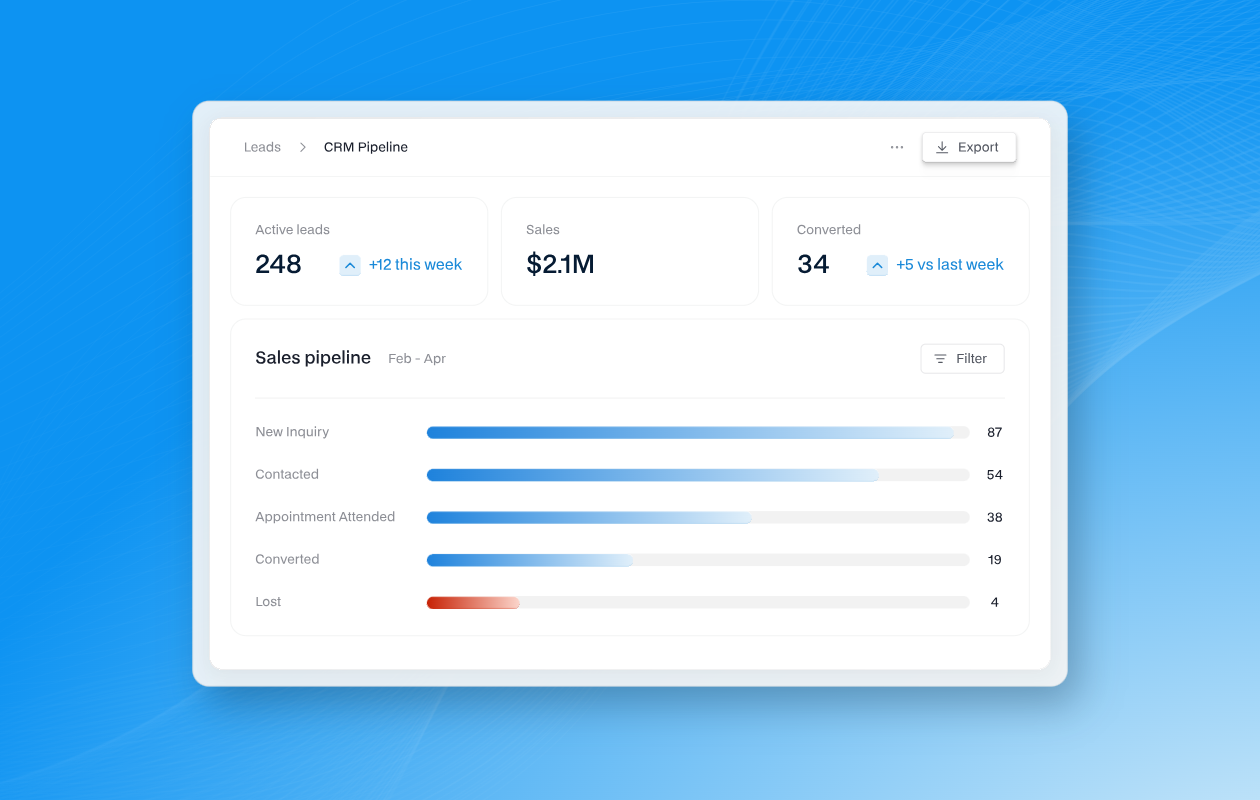
Every sales team has said it at some point: "Our leads are bad." It's the most natural conclusion in the world. You spend money on portals, paid social, or a project launch campaign, the enquiries trickle in, and only a tiny fraction ever turn into a contract. The obvious fix feels like more — more spend, more channels, more volume.
But when you actually look at where those leads go, the story changes. Most of them aren't bad. They're just never properly caught.
The Math nobody wants to look at
Real estate lead conversion is low by nature. Industry benchmarks put purchased online leads at roughly 0.4% to 1.2% conversion, while organic and referral leads run 2% to 5%.. On the higher-intent platforms it's a bit better — Zillow and Realtor.com leads convert around 5% on average, with top teams reaching 7% to 9%. Everywhere else, the "average" agent is closing somewhere between 1 in 100 and 1 in 250 leads.
That sounds like a leads problem. It usually isn't. That same Jamil Academy piece describes a real estate coaching client whose CRM showed 73 leads in 90 days, an average first-response time of over four hours, and fewer than two follow-up attempts per lead before the agent gave up. Nothing changed about the lead source — only the response time and the follow-up cadence — and the same pipeline produced four closings in the following 90 days. Same leads, different system.
Speed is the single biggest lever
If there's one number worth memorizing, it's this: agents who respond to a web lead within five minutes are roughly 21 times more likely to qualify that lead than agents who wait 30 minutes. Some write-ups put the gap even higher, citing contact-rate improvements of up to 100x for 5-minute vs. slower response.
A caveat on that last figure: the "5 minutes vs. 30 minutes" statistic traces back largely to a single, often-cited 2011 Lead Response Management / InsideSales.com study, and it gets repeated across dozens of marketing blogs with varying multipliers (21x, 100x, 391%) depending on the source — a sign it's being recycled rather than independently re-verified each time. Treat the exact multiplier as directional, not gospel; the underlying direction (fast response beats slow response, by a lot) is consistent across every source below.
Why does five minutes matter so much? Because a lead isn't a static file waiting patiently in your CRM — it's a person mid-decision. The moment a prospect submits an inquiry, their attention is at its peak; as time passes, that attention shifts to dinner, to work, to whichever competitor responds first. Speed isn't a nice-to-have on top of a good pitch. For a huge share of buyers, speed is the pitch.
And the real estate industry, despite knowing this, is slow. One industry benchmarking analysis found real estate averages roughly 47 hours to first response — among the worst of any industry studied, alongside legal (52 hours) and mortgage. Every one of those hours is a small, silent leak in the pipeline you already paid for.
The follow-up gap is even bigger than the response-time gap
Speed gets a lot of attention. Persistence gets almost none, even though it may cost agents more.
Roughly 44% of salespeople stop reaching out after a single follow-up attempt , while separate research from Peak Sales Recruiting suggests 80% of sales actually require somewhere between five and twelve contact attempts to close. In other words, most of the people responsible for chasing a lead give up right around the point where the odds of success start climbing. Note that the "44%" figure is one of the most widely recycled stats in sales content — it shows up, sometimes uncredited, across dozens of blogs — so treat it as a well-established industry talking point rather than a single traceable dataset.
Real estate isn't an exception to that pattern. Buyer-lead research suggests leads who receive six or more contact attempts convert at rates roughly 70% higher than leads who get fewer touches. That's not a marginal difference — it's the difference between a lead source that "doesn't work" and one that quietly becomes your best channel, just because someone kept showing up.
There's a timing wrinkle, too. Today's buyers — especially digital-native and millennial buyers, who make up the largest share of the market — often spend three to eighteen months researching before they ever contact an agent. A lead that goes cold after two touches isn't necessarily a dead lead; it may just be a lead who was never going to be ready on your first or second attempt, and needed the kind of long, multi-channel nurture almost nobody builds.
Half your leads show up when no one's watching
Here's the part that turns a follow-up problem into an infrastructure problem: roughly half of all real estate inquiries come in outside normal business hours, clustering in the evening and on weekends, and about 78% of buyers end up working with whichever agent responds to them first.
Put those two numbers together and the implication is uncomfortable. If you only respond during business hours, you're not competing for half your leads at all — you're conceding them by default, before you even know they exist. It's not that those buyers chose someone else over you. It's that someone else was simply there first.
What this actually means for your pipeline
None of this is an argument against generating leads — more volume is never a bad thing on its own. It's an argument against treating lead generation as the whole strategy while the back end of the funnel quietly bleeds out through:
- Slow first response — hours instead of minutes, especially outside 9-to-5
- Under-following — one or two attempts instead of the six-plus that actually move the needle
- No triage — treating every lead the same instead of routing high-intent signals (price-range searches, repeat visits, mortgage-calculator use) to immediate outreach
- Single-channel nurture — email-only sequences that go quiet by month three, instead of a mix of call, text, and email sustained over months
Fix those four things and the "lead quality" complaint tends to disappear on its own — because it was never really about the leads.
Where a purpose-built CRM actually changes the math
Most of the four leak points above aren't really sales problems — they're systems problems. A generic CRM (or worse, a spreadsheet) can't fix them because it wasn't built to. This is the gap platforms like Property Shell — a CRM built specifically for property developers and project marketing teams selling new projects — are designed to close, and it's worth being precise about what that actually looks like rather than hand-waving at "automation":
- Capturing every enquiry the moment it lands. Property Shell's CRM includes automatic lead capture and out-of-the-box integrations that pull in enquiries from every digital touchpoint — the website, portals, campaigns — into one centralised system instead of a scatter of inboxes and spreadsheets a team has to check manually. That's the precondition for fast response: you can't respond in five minutes to a lead nobody's noticed yet.
- Triaging leads instead of treating them all the same. The platform's Sales Optimisation feature scores leads algorithmically across roughly 50 metrics — things like call history, email engagement, and time since last contact — to rank which prospects are statistically more likely to convert. That directly targets the triage gap: instead of a sales team spending equal time on every enquiry, the ones showing real intent get surfaced first.
- Making follow-up a system rather than a habit someone has to maintain. Property Shell's Marketing Automation builds nurture journeys across email and SMS, and the CRM tracks every interaction and lead status in real time. That's the direct answer to the "44% quit after one follow-up" problem — the cadence runs whether or not someone remembers to send the sixth touch.
- Making the leak visible. Its reporting and metrics tools surface lead sources, conversion rates, and sales trends, which is what actually lets a team see slow response times or under-followed leads instead of only suspecting them.
None of this replaces good salesmanship, and no platform can manufacture buyer intent that isn't there. What it does is remove the structural reasons a decent lead goes cold — the enquiry nobody saw for four hours, the prospect who got one follow-up email and then silence, the buyer who submitted a form on a Saturday night and heard nothing until Tuesday.
The reframe
Before spending another dollar on a new lead source, it's worth asking a blunter question: of the leads already sitting in your CRM right now, how many were contacted within five minutes? How many got a sixth touch before anyone gave up on them? How many came in at 9 PM on a Saturday and waited until Monday morning to hear back?
For most teams, the honest answer is uncomfortable — and it's also the best news they'll get all year. It means the fastest, cheapest way to grow the pipeline isn't a new marketing budget. It's making sure the enquiries you're already paying for actually get caught, scored, and followed up before someone else gets there first.


Discover how Property Shell can accelerate your sales pipeline and automate manual ledgers.
