


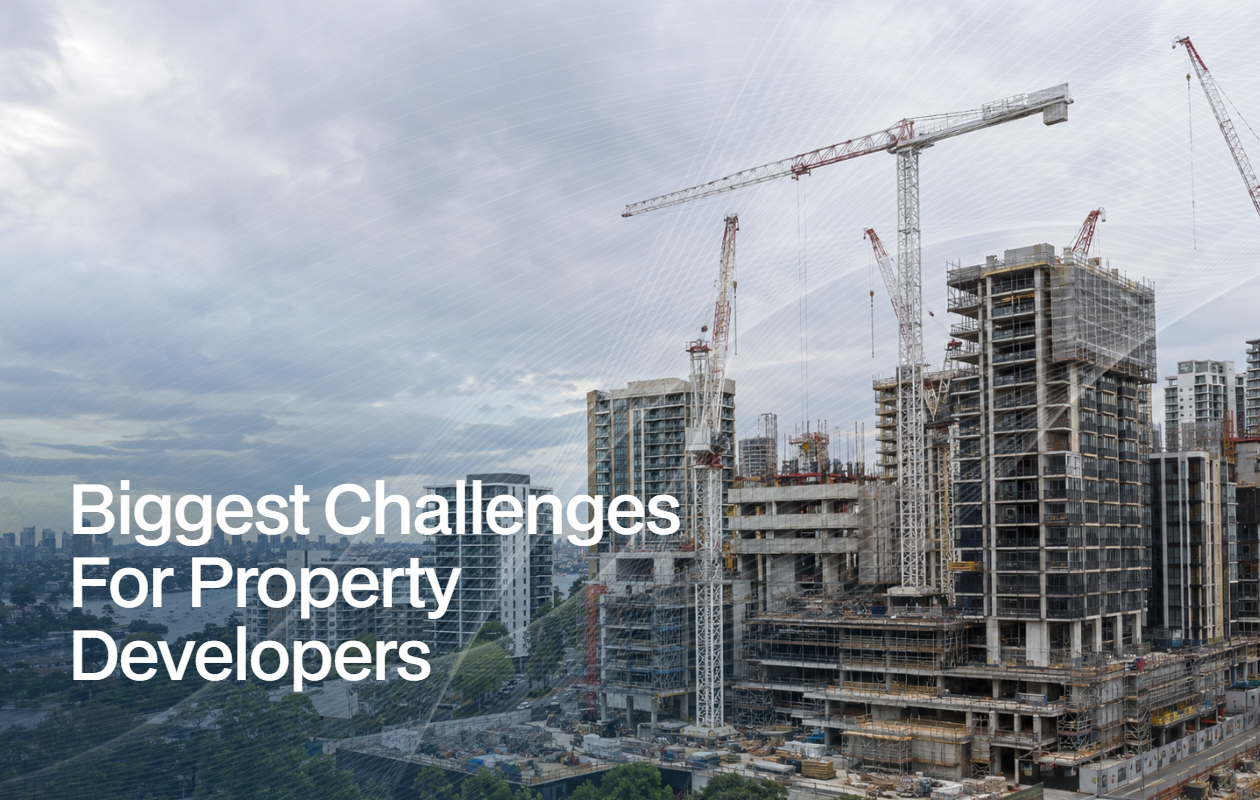
Australia's property development sector is being squeezed from every direction at once. Demand for housing keeps climbing, the national plan to fix supply is falling behind schedule, construction has become dramatically more expensive to deliver, and buyers have less capacity and less appetite to purchase — all at the same time. Here are the three forces reshaping the industry, backed by the latest data.
1. Demand is outstripping supply — and the 1.2 million homes target is slipping
In 2022, the Commonwealth, states and territories signed the National Housing Accord, committing to build 1.2 million new and well-located homes between July 2024 and June 2029 — an average of 240,000 completions a year, or roughly 60,000 every quarter. It was always an aggressive goal: the strongest year for home completions in the decade before the Accord was around 225,000 dwellings, meaning the industry was being asked to beat its own record every single year for five years straight, while also dealing with a chronic labour shortage.
The results so far confirm the scepticism was warranted. After the first 21 months of the Accord, Australia should have completed 420,000 homes; instead it delivered just 307,635 — a shortfall of more than 112,000 dwellings. Commencements have told a similar story: by March 2026, only 331,903 homes had broken ground against the roughly 420,000 needed to stay on pace.
The government's own National Housing Supply and Affordability Council now forecasts the target won't be reached until the end of 2030 — 18 months late — even though building approvals and commencements have both risen since the Accord began. Separate modelling from Master Builders Australia projects a final tally of around 1.03 million homes by mid-2029, a gap of roughly 166,000 properties. The Council's own framing is stark: for every five homes the target demands, the industry is on track to deliver four.
What this means for developers: underlying demand for housing isn't going away — if anything, the shortfall is compounding it — but the pipeline needed to satisfy that demand is structurally behind, held back less by a lack of appetite to build and more by the constraints covered below.
2. Construction costs keep climbing, squeezing project feasibility
Even where developers can get a project to the starting line, the economics of building it have deteriorated. Construction is one of the few sectors where output price growth is still running ahead of the broader economy — annual building construction output prices were tracking at around 4.2%, above the Reserve Bank's trimmed mean inflation measure, in early 2026.
Forecasters expect this to persist rather than fade. Rider Levett Bucknall's 2026 outlook puts cost escalation at around 4.0% in Sydney and Melbourne, rising to 5.0–6.0% in Brisbane, the Gold Coast, Perth, Adelaide and parts of Queensland. WT Partnership's national forecast (5.2% for building in 2026) is described as the lowest escalation rate in six years — and it still expects costs to climb to 6.4% by 2028. Brisbane is expected to lead the country, with building costs there forecast to rise around 10% as resources and labour shift north.
Two structural issues sit behind the headline numbers:
- Labour. The sector is short an estimated 141,000 workers nationally, and unions are pushing for pay rises of at least 4% in a market where Tier 1 subcontractors are already scarce. That combination pushes costs up regardless of what materials do.
- Materials and global shocks. Building material costs rose 2.5% in the year to March 2026 — the largest annual increase since 2023 — with some inputs moving far more sharply (plumbing supplies up 36% in a single month, timber up 15% in a month). Copper, aluminium and ready-mixed concrete have all seen outsized increases, and geopolitical disruption to shipping routes has added fuel surcharges and freight costs on top.
The flow-on effect is that fixed-price contracts signed six or twelve months ago are now being delivered into a cost environment they were never priced for, compressing developer margins and, in some cases, tipping smaller and mid-sized builders into insolvency — construction insolvencies jumped 42% between 2022 and 2023 alone, and the pressure hasn't eased since.
3. Higher interest rates are cooling buyer demand and tightening presales
The final piece of the squeeze is on the demand side of individual projects: financing costs and buyer capacity. After a brief rate-cutting cycle, the RBA lifted the cash rate three times in 2026, taking it to 4.35% by May before holding through the middle of the year — reversing the prior cuts and returning borrowing costs to levels last seen in late 2024.
For developers, this matters in two connected ways. First, higher rates reduce buyer borrowing capacity directly, which slows the pace at which apartment projects reach the presale thresholds banks require before releasing construction finance — industry commentary has explicitly linked the RBA's hikes to renewed pressure on project feasibility and presale campaigns, with one data release showing apartment approvals falling by almost 30% around the same time rates rose. Second, higher rates make buyers more cautious across the board: auction clearance rates in Sydney and Melbourne have dipped below 60%, and vendor discounting has widened, signalling a genuine buyer's market rather than the seller's market developers need to justify new stock at higher price points.
The net effect is a harder sell in both directions: it's harder to convince enough buyers to commit off-the-plan to unlock funding, and harder to hit sale prices that make a higher-cost project stack up financially in the first place.
The Bottom line
Australia doesn't have a shortage of housing demand — it has a shortage of homes it can actually deliver at a price the market can absorb. The 1.2 million dwelling target is slipping because construction costs and labour shortages have made supply expensive to build, while rising interest rates have simultaneously made it harder to sell what does get built. Developers navigating 2026 aren't dealing with one problem; they're dealing with a feasibility squeeze coming from both ends of the ledger at once.


Discover how Property Shell can accelerate your sales pipeline and automate manual ledgers.
